The Intro
I've been interested in the communication and cultural effects of online gaming and virtual reality both academically and as a parent. I also happen to be a SciFi fan, seen or read many stories centered around this technology dating back to at least 1960. The idea of a holo-deck as presented in Star Trek is intriguing to say the least. There are definitely days... However, in this blog I want to focus specifically on the worlds of MMO (massively multi-player online) gaming, the communities involved in it, and the communication/cultural effects of the technology. I'll preface this by saying my particular focus is not the effect of game violence. I am interested in the less visible phenomena of young people almost 'checking out' of their lives in favor of involvement in an online community and virtual worlds. The effect of online gaming on offline relationships, life, and personal growth. These kids don't hurt other people, don't attract major media attention... they just go quietly into their rooms and computers and stay, hours a day, coming out to eat or do other essentials they can't avoid... only to return as soon as 'humanly' possible.
I have opinions about the cultural effects. I have developed these opinions from my experience raising children (I have two, now 17 and 19) and speaking with other parents (extensively) and professionals in a variety of fields. I will relate the 'condensed version' of my experience to give you some perspective. I am still involved in this, to a lessor degree now as my son is an adult and is living on his own. It will be some time, I believe, before the saga plays out for us. It certainly does not hurt to take a moment with this blog and do some research on the communication and cultural effects of online gaming and to delve into some of the worlds available myself. The last computer game I played avidly (and it wasn't that avidly) was 25+ years ago. It was an entirely text based game called 'Adventure', we played it on a PDP-11 computer (you may have seen something close to this type of computer if you ever saw the move 'War Games'). My new flash drive does more than that computer could *grin* and it nearly took up the room. We played the game by drawing maps of the world so we could recall where the various avenues went. After that, I watched from the outside as the games became more and more complex and the audio/video became more and more real. I didn't have a real urge to give them a try because I had too much else to do, the games were so complex as to require a significant amount of time just to get started. I wasn't that interested. Now... with technology progressing at the pace it is... online games with full VR experience are not simply a Star Trek phenomena. They're coming to our homes. My children will struggle someday with this issue when they decide to have their own families. I believe it will be MUCH more difficult as these virtual worlds become even more real.
---------
The Background Story
As a parent of late model teenagers, I have watched the effect of online gaming on my son (who is the eldest). He is quite literally addicted to Warcraft. I use that word with some reluctance because I fully acknowledge that his gaming is a choice, there is no physical addiction. I do, however, believe there is a strong psychological addiction. There is something he gets from playing this game he does not get in real life. I have quietly watched him playing this game, using a headset and VoiP voice services to interact with other players, fingers moving like lightening over the keyboard. Hmmmm...
He graduated from High School but struggled as he played every trick in the book to try and be online all night. Tired in school, falling asleep at his desk, failing to do homework... he didn't care. His father and I did, of course. I won't bore you with our efforts to limit this and encourage him in positive directions, sports... travel... community service. As a parent you often struggle with forcing a hard line vs. teaching the child that what they are doing is harmful... one would like to think you can teach a child so that when they are up against a different problem, they can think their way through it... His father and I are both engineers, still had the upper hand when it came to technology. We were able to 'out tech' him and limit or eliminate access at home while still allowing him to do needed work for school. The fact of the matter is that until you have been through this and look back, I don't believe you truly understand what you're up against.
ANYWAY, my son did graduate from high school and went off to technical college the next fall (to study game and simulation programming as a matter of fact) but bounced out as he still couldn't resist the virtual world he was involved so intimately in. He quite literally had no real friends, his 'friends' were all involved in the game. He is presently living on his own, working at a fast food restaurant... got himself a place to live but it is unclear that he will be able to pay the rent... and all he's interested in is spending his spare time gaming. He will have to learn the effect this is having on his life on his own. The effects don't hurt... yet. He's had multiple people tell him he might as well be on some illegal drug for the damage this is doing. He doesn't care. I have visited him and he was gaming when I arrived. I watched as he came to talk to me... his hands were literally shaking with desire to go back on the keyboard. He was seemingly unable to sit for more than a couple minutes, getting up to go back on the game and returning. If it hadn't worried me so I would have been fascinated watching him.
A teacher mentioned Warcraft in class one day, in somewhat of a positive light. He mentioned what great leadership experience it provided. Now, I do understand that computer gaming has had some positive effects. I recall there have been stories from the military about how much quicker and more accurate the new generation is with the weapons technology because of their involvement in computer games. However, what I see from my own experience and from talking with other parents is a significant portion of a generation (anecdotally for me this is largely the guys, this doesn't seem to capture the girls attention to the same degree however! in doing the research below it seems the actual numbers may be something like 55% male vs. 45% female) withdrawing from real society in favor of a virtual one. I do not agree with the teacher's comment because I believe the people who assume leadership roles in these online games cannot (painting with a broad brush here) translate that skill into the real world. Those are two very different places and they only feel comfortable in one.
With my son, I fully believe that this is a maturity issue. He is not yet capable of understanding the effects because he doesn't have the life experience to do that. His priorities and thinking processes just aren't all jelled yet. I spend a great deal of time simply keeping the lines of communication open in a positive manner with him. When possible, on those rare occasions I now have to get his full attention, I will try to talk to him, try to gain some insight, try to get him to think about what's going on with him... it's tough. He reacts just like an addicted person 'I don't care' 'it's not a problem'. He truly doesn't care right now. I'm not the only one struggling with this. Right now, society as a whole is not paying attention. Parents struggle with it alone or in small groups for the most part.
I will continue to do whatever positive things I can and to wait him out. It's hard waiting. He's never off my mind. I decided to write this blog to put my own thoughts in some semblance of order and to see what I could learn in a broader sense about this area... admittedly too, if there is any possibility that some young person sees themselves in this blog they may get some insight that they might not otherwise have gotten. I can always hope.
---------
The Delving
I am rather limiting my delving into the online worlds for the sake of limiting the length of this blog and giving myself time for other homework. However, I did explore several games I found in the Flash Forward Conference finalists in the game category. The first game was CDX. I didn't go very far, merely explored the room 'wheelchair guy' was in. The level of realism was fascinating. Personally, I have trouble with exploring the room long enough to discern what to do next. I poked around and made 'wheelchair guy' roll from one side of the room to another, picking up this and that and reading EMail and started to see some pattern to the information presented emerge. I have to admit, I rather liked the site by papervision.org under the 3D category better... but them I'm a scuba diver and I found the level of realism to this animation somewhat dizzying. Very cool... just like where I went diving off Moorea, minus the shark. However, admittedly since that was not a game it is of limited interest I just liked the content better. I also tried ESPN Bar Games, kinda boring. Bible Fight and Obon Star Racers were also kinda boring. Plus, with Obon the music made me want to throw my computer across the room. I find I have more affection for the more realistically rendered games, so for me... CDX was the most interesting of these (and the winner of the category). I actually could have hung around awhile and probed for the next step in the game. The quality of my monitor had a big effect. I've got a much nicer (larger, higher resolution) monitor now and yeah... made it much more interesting to get involved. My personality though, for me... just takes too long, I get impatient. Not that interested so I can see that I definitely am going to have trouble personally relating (not that I haven't had this difficulty all along).
SO, I decided to move over and examine my nemesis. Went to warcraft.com. Well, since I also love LOTRs... the storyline and art style in this game was appealing. MAN I am ignorant of these games... the modes to the game (normal, PvP, RP... learned some new acronyms... if you're also uninformed... you can play in normal mode where other players cannot attack you, player-vs-player mode where they can, and role playing where you have to be your character), the realism of the motion of the characters, the detail in them... I wasn't really prepared for that, it was fascinating. I tried to take advantage of the free 10-day trial but the sign up software wasn't quite working right. Perhaps I'll go back to it later. If I do, I may add to this section of my blog a bit.
I've also heard a lot about Second Life. I've also heard many spouses or significant others of a 'second lifer' repeat the now widely selling t-shirt phrase 'Get a First Life'. I looked at the website. Didn't do anything for me. Hummm... and I admit, if my spouse was online hours a day on any site... much less this one... I'd be considering looking for a new spouse. Not acceptable in personal relationships.
Bottom line - in spending just a bit of time looking at these games, I did find what I was guessing... if you were inclined to explore, the motion/audio and the storyline of something as complex as Warcraft lends a level of reality that is beyond what I personally have experienced in a computer game before. I can extrapolate what adding the 'remote human' interaction and role playing could add to the experience. Then you are no longer simply playing someone else's story line. You may still be in their world, but you are using it to create your own society. OK, yeah... my son is in there someplace leading campaigns. I can intellectually relate. Still not liking it, but yeah... I can start to see emotionally how he could become so involved. He feels important and valued here at a level that he doesn't feel outside in the 'real world'. Kinda scares me a bit.
*shaking it off* I think what goes along with this is that gamers feel an increased level of control in their virtual world as opposed to the real world. I also note the increased rate of action vs. result. In real life, often it can take many years of schooling to achieve a goal. In a virtual world, not so much. Lastly, what strikes me is that 'personal interaction' in these games is not personal which exceedingly lowers the 'threat level' if you will. Whatever happens there, it's not the real you... you are someone different there. That capability to recreate yourself, to be someone you are not in real life, is... attractive.
---------
The Research and Resources
Again, due to time and length constraints (yes, I know I've already exceeded a page...) and noting people get degrees researching this stuff, I skimmed rather than read in depth a number of articles and resources I found online. MOST of them were focused on the effects of violent games and the correlation of this type of game playing with school violence etc. Not my issue at the moment.
To give context, we now appear to be at a developmental focal point for the technology of interactive entertainment. Some describe it as the infancy of the industry and liken it to the dawn of television. The industry itself is a mere three decades old but it is now so pervasive in everyday life that it is "changing the way an entire generation sees itself in relation to the world, expanding popular storytelling beyond passive consumption to include involvement in the development and outcome of an experience". But what is so interesting is how the games themselves have a stake in how it evolves. The industry is experiencing explosive growth even while costs to develop a new game (I'm sure now well) exceed $10M [5]. The realism, capability, and flexibilty of the games has pushed beyond (simple?) MMO boundaries as 'mod' games appear [5]. "Short for modification, mod games are variations made by fans on existing games. These underline the spontaneous creativity in the vast online communities." Game companies rationalize that (quote from the Entertainment Software Association's Lowenstein, [5]) "Online games have the potential to transform entertainment into a global-community exercise, breaking down borders, cultural and language barriers, and even political prejudices."
Some newer articles [1] focused on the function of these multi-player games as informal social gathering places and support networks, calling them 'third places' (home and school/work being the first two). The articles all require some time to assimilate but there does seem to be a core debate about whether these 'third places' are positive areas of social interaction bridging racial and class divides, exposing the user to broader world views or whether they are a great 'displacer' enabling (otherwise useless) 'pseudo-communities'. They make mention of gamers playing 8-12 hours a day at times, but do not really delve into the effect of that level of 'checking out' on their lives. Article [1] examined rather the quality and composition of the relationships formed online.
One article got a bit into the area that I am interested in [7], citing a quote that "The opposition of real and virtual … misses the complexity and diversity of relationships that people may pursue through the communicative media that they embed into their ongoing social lives.” It went on to say that in surveying the players, they did not find a significant weakening of offline relationships due to online gaming. They were really focused on inter-personal relationships rather than the larger problem I'm seeing. I had trouble with this article, there is some truth to what they're saying but I believe their method of research was faulty. What I saw in my son was that online relationships did replace offline relationships, that was part of what bothered me... and given the amount of time that some of these gamers spend online, certainly... perhaps unquestionably in my mind, the depth of all relationships is sacrificed. This seemed to be coming out in a quote I found in a forum credited to a Carnegie Mellon study [8]. "The Carnegie Mellon researchers found that interpersonal communication – communication for social purposes – is the dominant use of the Internet at home. However, contrary to expectations, they also found that increased Internet use among the study’s participants 'led to their having, on balance, less social engagement and poorer psychological well-being' ." It's very interesting to read through the online discussion of this study.
In regards to my choice to reluctantly use the word 'addiction' a blog [9] referring to an article in the Philadelphia Inquirer states "As the sophistication of this technology increases, more people are sucked into this virtual world and begin to develop real psychological problems such as social isolation, depression, difficulty in work and relationships, and being disconnected from reality. Fortunately this article gets it right, this type of behavior is an impulse control disorder like pathological gambling not an “addiction” per se." Yeah, agreed. It goes on to say "I think for some people that MMORPGs can provide a valuable style of social interaction, but it can become problematic when more time is spent with this depersonalized interaction than real interaction with other people." TOTALLY dude. That's the problem I'm seeing, at least part of it.
There are a few articles discussing the differences in national and social values to new technologies such as online gaming. In particular [6], examines how Singapore reacts to gamers (my son should be glad he doesn't live in Singapore since we caught him doing the same thing). A snippet from this article relates: "In December 2006, the local Singapore newspaper, the Straits Times, reported that a teenager had been arrested and sentenced to early military service for illegally accessing a neighbour’s unsecured wireless network. The boy’s parents, concerned by their son’s moodiness and declining academic performance, had decided that he was spending far too much time on gaming. Enough was enough: they unplugged the household modem. The boy’s response was to take his laptop outside one evening, wandering round the neighbourhood until he found an unsecured wireless network to tap into. There he was discovered by a neighbour, who confronted him and then called the police after the boy allegedly became aggressive. Then on January 17 2007, the newspaper ran a follow-up story: ‘Is there a gaming addict in your home’? The way in which one family’s issue was used to feed existing concerns about online gaming in Singapore, and to create an impression of gaming as a runaway social issue, was telling."
Some additional resources available online:
[1] Games, Gamers and Gaming Culture This website contained links to university and IEEE and other reliable research organizations studies. Unfortunately, the material on the site is largely about five years or more old. The site does not appear to have been maintained after about 2001. Nevertheless, there was some interesting information there.
[2] "Where Everybody Knows Your (Screen) Name: Online Games as 'Third Places' " Steinkuehler, C., and Williams, D. (2006). from the Journal of Computer-Mediated Communication This article examines the form and function of massively multiplayer online games (MMOs) in terms of social engagement.
[3] "Cultural Framing of Computer/Video Games" from the International Journal of Computer Game Research volume 2, issue 1 July 2002
[4] "Video game music: not just kid stuff" Matthew Belinkie (matthew.belinkie@yale.edu) 15 December 1999
[5] "Video-game industry mulls over the future beyond shoot-'em-ups" Computers & Technology, June 03, 2005 edition
[6] "Online-Gaming: Moral Panic in Singapore" Catherine Howell (University of Cambridge) on January 25, 2007
[7] Game Studies "Living a Virtual Life: Social Dynamics of Online Gaming" Castulus Kolo and Timo Baur, International Journal of Computer Game Research volume 4, issue 1 November 2004 This article studies players of Ultima Online.
[8] Forum booktalk.org > Science, Nature & Technology > The Problem of Technology -- Part II: The Internet postings from 2002
[9] "Online Gaming Addiction?" PsychCentral website archives Will Meek October 12, 2006
[10] "Negative Aspects of Online Gaming" seems to date around 2001 A lot of annocdotal accounts that are kinda interesting.
---------
Lastly, The Conclusion
Technology, particularly media technology, has always brought with it societal fears. The point of this blog is not to spread or even suggest that we should fear, rather to point out that there are definite, recognizable, effects around us today of this technology.
Are online games bad? Should we outlaw them? OH, get real. That's ridiculous. I fully stand behind freedom of personal choice. You cannot legislate maturity or intelligence.
Online games, like a number of other things, are only harmful to the person when the person involved in them steps over the threshold. The threshold is where they give up some level of fully functioning in society in favor of living in a virtual world. When this happens, society suffers. That person contributes to society at a lesser degree... certainly some extreme cases cease to contribute. There are effects on families, on personal relationships, on the person themselves as they limit their own personal growth. AA talks about how alcholics stop their personal growth during the time they are drinking, that is true here as well. When you don't deal with real life problems, you don't grow. I think describing what I referred to as an addiction as an impulse control disorder is tellingly more accurate and that, probably more than any other phrase I read changed the way I was viewing this problem. Looking at it more like a gambling problem than a drug or alcohol addiction puts it in another frame of reference entirely.
Do I have a solution? Well it is clear to me that education and personal growth are the only solutions (to a lot of problems). Society has to become more aware of what is going on, as a society. Pull this further out of the realm of research - talk about this, study it, debate it... find ways to guide young people without boxing them in. But outlaw or stop the growth of technology? I'm not in favor of that. I don't believe in limiting the human potential. But we have to evaluate the impact of each step and to make purposeful decisions... to be as aware as we can of the effects of our research, explorations and development. Always question, never assume or blindly accept. Society is starting to explore and debate the effects of violence games on the violence in society. What I am focused on, however, is a less visible somewhat silent repercussion. To the best of my ability to discern, what I'm focused on is still more in the area of an academic discussion than a broader viewed societal problem.
On a parenting level... if, as a parent, I was allowed a 'do over' with the knowledge and experience I have now I would not have allowed my children to play computer games from home, period. I would have spent more time involving them in sports and community service, finding ways to challenge and interest them in the world around them. My son has always been behind the maturity curve for his age. I do, however, believe that there would have been a reduced chance that he would have involved himself to this level had he not encountered it as early as he did.
At 18, all bets are off. However, making adults responsible for their own choices helps. We all rarely stop doing (whatever) until it hurts. Parents have to be brave enough to not get in the way of their adult children encountering this hurt. We cannot rush in and fix their problems. We have to stand back, offer love, information and encouragement but let them fix their problems themselves. Hard to do. Sure. Who cares? It's the right thing to do. If we look back to the time when WE were 18 and knew we were smarter than our parents... what else would have (or did) convince us? Nada, zip, nothing. That's it, experience.
I also fully back the idea of EVERYONE doing two years of service to their country out of high school - in the area of their choice - be that in the military, in Americorp or some other area of community service, in conservation... I'm completely open on that point, but doing SOMETHING would help us all at that age appreciate what we have, who we are, and what we can do when pressed. Having some real knowledge of that helps all of us focus and make better decisions.
I fully expect to see 'Gamers Anonymous' cropping up soon though. Probably wouldn't hurt.

Sunday, October 21, 2007

Wednesday, October 10, 2007
Artist Exploration: Alexandre Soubrier
Alexandre Soubrier created the site http://www.moonpalace.fr/ to showcase his work and projects as a freelance designer though an interactive flash site. I found the overall design concept appealing because it is both simple and unique at the same time. When I rolled over each of the "moons" the central planet stoped its rotation making its individual parts, such as the lighthouse, or the ship on the ocean more clear. Also, each of these areas of the planet have their own timelines which cycle, like the waves or the trees blowing in the wind. By navigating the mouse to the different "moons" orbiting around the central planet, I was able to explore the different projects completed by the artist include a variety of flash sites, animation for friends, logo designs, still drawings, and more in-depth advertising projects. The music and sound effects complement the design of the site, and there is a link to the musician's website http://www.potenciel.com/ which is also a flash site designed by Soubrier.
Tuesday, October 09, 2007
I was both shocked and intrigued by the website www.littledeviant.com. We have all experienced the sensation of watching something that gave us a queasy excitement...a mixture of ......this is awful...in horrible taste.....but I can't look away. I could not stop playing the wretched violent games in this website only to be pleasantly surprised at the very end with something "deviantly sweet" that made me laugh out loud !
The market objective of this website is to sell scion cars. The dilema in advertising today is how to reach the demographic of the prized 16-24 year olds who yawn at most attemps to get their attention through traditional advertising. Focus groups inform us that advertising telling kids what to buy is like their parents telling them how to dress. Ineffective and just plain icky. How then to reach this age group that has literally been given school courses on the deception of modern advertising. Scion, a division of Toyota is attempting to sell inexpensive cars targeted to young people. It hopes to make a Scion their first car and build brand loyalty. The cars can be customized reflect the uniqueness of the buyer. The website attempts to use games and black humor to tell buyers to resist conformity and dull compliance. Be a little deviant.
Susan Blessinger
The market objective of this website is to sell scion cars. The dilema in advertising today is how to reach the demographic of the prized 16-24 year olds who yawn at most attemps to get their attention through traditional advertising. Focus groups inform us that advertising telling kids what to buy is like their parents telling them how to dress. Ineffective and just plain icky. How then to reach this age group that has literally been given school courses on the deception of modern advertising. Scion, a division of Toyota is attempting to sell inexpensive cars targeted to young people. It hopes to make a Scion their first car and build brand loyalty. The cars can be customized reflect the uniqueness of the buyer. The website attempts to use games and black humor to tell buyers to resist conformity and dull compliance. Be a little deviant.
Susan Blessinger
Sunday, October 07, 2007
Artist Exploration: Ruperto Fabito Jr.
 Ruperto Fabito Jr. calls himself "a hybrid designer, specializing in interaction and visual design." He is a talented artist and designer who works with different mediums, including web, broadcast, and print. I found his website on the fwa site, where he was awarded S.O.T.M. - Site Of The Month - for his creation of the application Paper Critters. Ruperto describes it as "a viral web application where users can create and share paper toys."
I explored the application, and found it to be original, well designed, and just plain fun.
 The interface is straightforward and easy to navigate, it gives proof of his talent with layout and design. The application allows the user to be the creator of your very own paper critter. You can
 customize your critter using a variety of stencils and tweak those to your liking with options for size and color. Or you can draw freehand using the drawing tools. Once you are finally done creating your masterpiece, you can submit it to "The Colony", the name for the database where all the critters are stored, and if you like, even print it out. Once you print it out, you can follow the instructions to make the 2D
printout become a 3D critter. Try it out!!
Animated and Interactive Picasso Gallery

This project caught my eye because of its use of 3D Actionscript animation. The Layout is clean, effective, and visually appealing. It reminds me of design that is used by Apple. Good Design.
Subconscious Influence: The Effect of Advertising

I like this project because it makes light of the fact that, we are influenced by our surroundings and I thought it showed a lot of creativity. At first, I did not know what to do but, after the horns started honking, I knew I needed to get a move on. Ruperto even takes a shot at the iPod advertisement. I liked this one.
One of the aspects I liked the most in Ruperto's designs, was the use of sound effects their ability to put a smile on my face. On his main site each rollover is greeted by a simple sound bite and when you click on it you are alerted with a different sound. I find his work to be both effective and innovative. It accomplishes its intended purpose by reaching the audience and involving them in the experience.
Saturday, October 06, 2007
Arj and Poopy

The next SpoungeBob Squarepants? I found this site on the FlashBack awards site and decided to write a blog on it when I woke up the next morning singing the Arj and Poopy song.
The site is not created to be a interactive site, but rather of a display of Arj Barker's cartoon and animation talent in Flash. Arj has a good use of shadows and lighting, perspective, angles and synchronized movement to sound.

Episodes:
Unlucky in love: http://www.arjandpoopy.com/ep7.html
Congo Windfall: http://www.arjandpoopy.com/ep10.html
Games: http://www.arjandpoopy.com/xylophone.html

Zylophone uses interactivity with buttons and sound. The arj and poopy song plays In the pitch according to where you click on the scale.
http://www.arjbarker.com/videos/
About Arj Barker
Legal Name: Ricky Shroeder
Age: 28
Date of Birth: Aug. 12, 74
Place of birth: Vagina
Occupation: comic, actor, writer, fisherman.
Thursday, October 04, 2007
Design Exploration: H8US
This site is called H8US.com and it is based on a clothing line created by 3 guys living in San Francisco. It all started with two guys named SBG and Cashon D. They grew up in poor neighborhoods and always loved art and music. Then Cashon D met Deadbeat and realized what a good artist he was. He did really good graffiti and was musically talented. So Cashon introduced Deadbeat to SBG and SBG suggested that Deadbeat put his art onto shirts so from there the 3 guys created the clothing line H8US.I was introduced to this site by one of my co-workers and was immediately interested in it. The site features products, their background, along with new, etc. The first thing I really like about their use of flash is how all their buttons are all placed in a column and when you roll over the button you want it increases in size making it more noticeable. The colors are used very nicely with the black and red theme. They have their artwork located in the background so that the site portrays what their about. The graphics for their web address is simple but interesting. Another cool feature is that when you click on a certain button the graphic behind it represents the word. For example, when you click on the production button a piano is shown in the background. As you click on a button black stars shoot across the screen and jump around in sync with the background music.The one part they succeeded in their flash presentation was in their music and sound affects. When you click on a button it makes a bold noise and then the music starts up. All the sounds relate to the image you are seeing which really brings the presentation together.Overall the site is very clean and successfully portrays the kind of clothing they sell and what kind of music they play. I loved the use of color and sounds along with the clever, simple set up H8US had. www.h8us.com
Design Studio Exploration: World Domination Design Group
 By Justin Henk
www.wddg.com
World Domination Design Group is a premier interactive advertising firm with expertise in interactive design, interactive video, technology, and game development. Flash is the primary tool they use however they do leverage other technologies. They offer creative solutions that will challenge the way the internet has been used in the past, and shape the way content will be delivered in the future. Some of their designs have been trendsetters for online interactive advertising.
WDDG, established in1998, has won many prestigious advertising awards. The company is small enough that they have a very close relationship with their clients, including a lot of face-to-face time for brainstorming and development. The developers look for ways to have fun with the projects, and are best known for their creative design skills. The company looks to intrigue and enthrall their audiences with unique cutting edge content. With many prestigious clients such as American Express, Visa, HP,

One of their clients websites I was attracted to was www.altoids.com. The site employs interactive video, music animation, and games using the flash platform. The vaudeville theme provides in interesting backdrop packed full wacky characters, with whom you can play games, watch singing performances, watch puppet shows, send people singing love telegrams, or draw beards on the bearded man. The site is very well designed and easy to navigate and interact with. The integration of video, art, and animation really make this site come to life.
Wednesday, October 03, 2007
Design Exploration: The Go! Team


The Go! Team is a unique band from the U.K. A blend of cheerleader chanting, crazy guitar and even turntables at times make categorizing the music into a specific genre very difficult. The band website reflects the crazy blend. Flash is the perfect tool for mixing sketchbook drawings, sound and animation. The rollover effects make navigating the site exciting. Contrast the official U.K. website with the official U.S. website and you will see what i mean...BORING!
What I like most about the artwork is that it actually looks like artwork. The sketches give the site an organic feel. The site is very simple without being too rudimentary and is a perfect example of what can be done to link analog and digital art as well as music at the same time.
Tuesday, October 02, 2007
Design Exploration: History.com
 History.com is the official website of The History Channel. This site provides media on history and interactive flash along with their scheduled shows for the day, among other things.
What I like about history.com is the vast amount of media to look at, ranging from actual sound bytes/video clip of an actual historical event (for example President FDR asking Congress to declare war on Japan after the bombing of Pearl Harbor) to video clips on shows they've previously aired on tv.
Even though there may be some flash involved within their media section, a fairly good portion of the flash components that we have worked on in class is actually in the games on the website. The type of games on this website is directed towards a pretty young audience (I'm guessing junior high). However, what I personally like about these games is that the majority of it is not your prototypical type of flash games online where you play just for the fun of it, but rather (in one sense) some of these games challenges the audience to put their knowledge to the test.
In addition, some of the content that is already in their games could be expanded and further developed (perhaps something like having an interactive flash timeline/map of the Battle of Gettysburg which could attract younger audiences into learning about the Battle of Gettysburg in a fun and interactive way).
-EHY
Monday, October 01, 2007
Design Exploration: Homestarrunner.com
The site I selected for my Design Exploration is Homestarrunner.com.

This site is operated much like a fanzine/fansite with updated episodic content in the form of cartoons. The tone of the site is very much in the vein of irreverence and silliness covering such random topics as videogames, caffeine, techno music, etc...
Homestarrunner.com features a cast of oddball characters each with their own distinct looks, voices, and personalities. The main, and probably most popular, character of the cast is named Strong Bad. He's a short, bare-chested fellow who sports a red, mexican, luchadore wrestling mask. Yes, you read that right... :)


One of the most popular sections of the site, which features Strong Bad, is called Strong Bad Emails. Here, actual letters submitted from fans are featured in the section as Strong Bad reads them aloud and then responds to them in his own, comical way. Here Strong Bad responds to an email asking about Action Figures.

Though decidedly, and probably deliberately, low on the technical proficiency or flair of many other flash powered sites, I've been a big fan of this site because of its brand of irreverent humor. Another hallmark of this site that I enjoy is how they incorporate the flash
"roll over" button functionality. During some of the cartoons found throughout the site, especially during Strong Bad Email segments, hidden roll over buttons will be placed over specific parts of the screen. Clicking on these opens up some other piece of content, usually occurring with (or above) the main segment currently in play. What makes these roll over button interactions fun, aside from the obvious fact that they are hidden, are that they are oftentimes occurring in a sort of "real-time" manner where you usually only have a short amount of time to both locate the hidden roll over area and click on it before the segment "times out." Here is an example.
(hint: keep scrolling over the text as Strong Bad types them on the monitor screen)
The very nature and implementation of these hidden roll over buttons lends a certain games element to whole package as well as helping keep readers on their toes.
What I found interesting with this site was how a specified low number of Flash functions were purposely implemented and highlighted to uniquely deliver the site's content despite the plethora of powerful features Flash offers. I feel Homestarrunner.com proves that a site need not necessarily incorporate all of the bells and whistles Flash has to offer to be an effective and entertaining one.
-Jeff J.
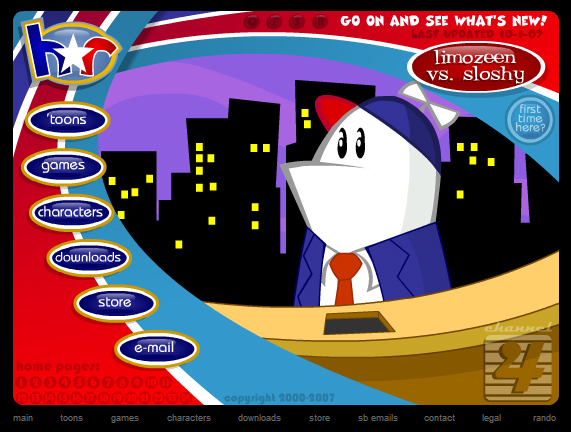
This site is operated much like a fanzine/fansite with updated episodic content in the form of cartoons. The tone of the site is very much in the vein of irreverence and silliness covering such random topics as videogames, caffeine, techno music, etc...
Homestarrunner.com features a cast of oddball characters each with their own distinct looks, voices, and personalities. The main, and probably most popular, character of the cast is named Strong Bad. He's a short, bare-chested fellow who sports a red, mexican, luchadore wrestling mask. Yes, you read that right... :)


One of the most popular sections of the site, which features Strong Bad, is called Strong Bad Emails. Here, actual letters submitted from fans are featured in the section as Strong Bad reads them aloud and then responds to them in his own, comical way. Here Strong Bad responds to an email asking about Action Figures.

Though decidedly, and probably deliberately, low on the technical proficiency or flair of many other flash powered sites, I've been a big fan of this site because of its brand of irreverent humor. Another hallmark of this site that I enjoy is how they incorporate the flash
"roll over" button functionality. During some of the cartoons found throughout the site, especially during Strong Bad Email segments, hidden roll over buttons will be placed over specific parts of the screen. Clicking on these opens up some other piece of content, usually occurring with (or above) the main segment currently in play. What makes these roll over button interactions fun, aside from the obvious fact that they are hidden, are that they are oftentimes occurring in a sort of "real-time" manner where you usually only have a short amount of time to both locate the hidden roll over area and click on it before the segment "times out." Here is an example.
(hint: keep scrolling over the text as Strong Bad types them on the monitor screen)
The very nature and implementation of these hidden roll over buttons lends a certain games element to whole package as well as helping keep readers on their toes.
What I found interesting with this site was how a specified low number of Flash functions were purposely implemented and highlighted to uniquely deliver the site's content despite the plethora of powerful features Flash offers. I feel Homestarrunner.com proves that a site need not necessarily incorporate all of the bells and whistles Flash has to offer to be an effective and entertaining one.
-Jeff J.
Syrup!


Syrup is a multidisciplinary design studio based in New York City. Syrup has worked with many well-established clients such as Yahoo, Food Network, Samsung, Lycra, MTV and James Perse. Other than serving as a online portfolio, syrupnyc.com offers news updates awards they have recently won and nationwide campaigns they have recently created.
Initially, I was attracted to syrupnyc.com becuase of its aesthitic appeal. The color palette syrup uses is a combination of colors that work well together and really stand out on a black and white background. Also, the colors seem to work well with the geometric and abract shapes that seem to float around throughout each page of the site. Each page of the site is designed with the same colors and shapes, however each page is surprisingly refreshing and unique.
All of the design choices made were intune with the concept of their site. My favorite part of the site in the opening flash movie clip. It is simple and well-contructed, and definitly leaves you wanting to see more of the site. The transitions from page to page, are also a smart way of keeping the audience engaged in the site, so that they may view the entire site, without the temptation of leaving or closing their browser window.
One downfall to this site however, is the amount of time it takes to view all of the images within their portfolio section. Some images take to long to upload, while some other images, don't seem to upload at all, which can be be frustrating if the audience doesn't have the fastest internet connection.
Studio Exploration
From Andy Steiner - Infrared.radio is for another website I run.
Capacitor Design Network
Capacitor Design Network is a trendy, cutting-edge style studio. The company started out making light Flash websites, utilizing minimalist GUI. From there, they designed the award-winning website for the award-winning program Delicious Library. This website had an incredible impact on the Macintosh GUI/Shareware community. The website was informative, but stressed form over function. This, coupled with the recent trend in eyecandy-oriented shareware, coined the term Delicious Generation, But I digress. I found their work uses powerful color combinations as well as small details that make the design really come alive. For instance, in their designs for Anon Optical Goggles, the whole goggle is a part of their design, not just the faceplate. The Strap is printed, and the design allows for integration of the Foam, not just ignoring it. If you look at their His and Hers CD, you can see all of the detail put into something that usually looks incredibly formulaic. There is so much subtle design in the rabbits and the color choice really adds to the “Victorian - era” motif. Unlike many of the modern CD cases out there, the booklet interior carries the motif as well, instead of just spelling everything out in the general Sans Serif font (usually Myriad). The CD itself is covered in the same design, and just as complex. My favorite designs, though are the OM Bassnectar and the Delicious Monster website, although the URBANRUSH website is also quite nice. I have fount that their art appeals to me because although it can be incredibly complex, the overall piece is to the point, and very quick in divulging it’s information.
Website Design Explorations
The two sites I chose were
http://halo3.com/believe/shell.html
and
One site I chose to explore was a site made in flash for the new game, Halo 3. It is the most amazing piece of work for a flash site I have ever seen and I can say I have no idea how it was done. It allows the movement through a virtual 3-d battleground. Even though the only movement is the camera you see it through, there is still sound that is very fitting to the scene. There is a great amount of consistency throughout it of soldiers, explosions and your general war images. It almost feels realistic. There are stop points with perfect alignment to learn about what going on along the journey you take, and the best part is you get to control where to go. There is definitely clarity and cleanliness, along with other design aspects. It is very easy to maneuver.
The next site I chose was a site for a upcoming movie called Beowulf. This site is a bit less interesting however well done nonetheless. The walk through mead hall definitely lacks content, it feels empty but if you explore it enough and listen in you can get a feel for the movie.
Design Explorations
When we first learned about the design exploration blog assignment I wasn’t too worried about finding content. Every time I spend more than five minutes online I see a flash site. There are many great examples out there, here are a few I found while poking around on social news sites Digg.com and Reddit.com.
The first site I found was an evolutionary timeline built in flash. The site had a great way of presenting information interactively so I decided to see who the designer was. That led me to this site: http://www.johnkyrk.com/. His entire website is composed in flash. In his profile he says that he is a biologist by education and an artist by disposition. On the front page he links to his various projects which include animations of cell biology, visual evolution charts, interactive PH charts, and architectural diagrams all done in flash. There are many studios out there but this person just wanting to share something interesting was able to publish this himself which I can really appreciate. To me the most interesting thing about his website was his style of presenting the information. He visualizes concepts in a unique ways to get his point across.
The Next website I found was on a little lighter side. Have you ever been at work and needed to zone out for awhile? Is solitaire getting boring? More and more people are finding online flash games. They are small games which can be loaded and played inside the browser using flash. I am not a big fan of computer games and don’t own a game console but the flash games online can be very fun and entertaining. One such game I found was from a company called maidmarian.com they have a game called Tank. It is found at www.maidmarian.com/Tank.htm . This is an addicting game completely done in flash. The game is multi player allowing your to interact and play with several opponents at once. The thing that really intrigued me about this game was the complexity of all the interactions. It must have been really difficult to make a symbol drive, shoot, and interact on a multi player 3D surface. There must also be a lot of physics at work to determine fluidity of motion between the characters.
The first site I found was an evolutionary timeline built in flash. The site had a great way of presenting information interactively so I decided to see who the designer was. That led me to this site: http://www.johnkyrk.com/. His entire website is composed in flash. In his profile he says that he is a biologist by education and an artist by disposition. On the front page he links to his various projects which include animations of cell biology, visual evolution charts, interactive PH charts, and architectural diagrams all done in flash. There are many studios out there but this person just wanting to share something interesting was able to publish this himself which I can really appreciate. To me the most interesting thing about his website was his style of presenting the information. He visualizes concepts in a unique ways to get his point across.
The Next website I found was on a little lighter side. Have you ever been at work and needed to zone out for awhile? Is solitaire getting boring? More and more people are finding online flash games. They are small games which can be loaded and played inside the browser using flash. I am not a big fan of computer games and don’t own a game console but the flash games online can be very fun and entertaining. One such game I found was from a company called maidmarian.com they have a game called Tank. It is found at www.maidmarian.com/Tank.htm . This is an addicting game completely done in flash. The game is multi player allowing your to interact and play with several opponents at once. The thing that really intrigued me about this game was the complexity of all the interactions. It must have been really difficult to make a symbol drive, shoot, and interact on a multi player 3D surface. There must also be a lot of physics at work to determine fluidity of motion between the characters.
Sunday, September 30, 2007
TECHNOLOGY: Hardware manufactures are finally making easy-to-use media boxes that will bring the web to the living room.
Streaming Videos Hosted On-Line to Your TV.
In my quest to self publish, promote and distribute my DVD/video, The
Full Circle Hula Hoop Workout DVD, www.hulahoopstar.com
to TV sets Worldwide,
I investigated the following Streaming Media Devices and Video Download Service options:
• Itunes + Apple TV: www.apple.com/appletv cross platformTV media hub. Playback is limited to formats playable within Itunes. HDTV only.
• XBL on 360: www.xbox.com/live/
• TiVo: TiVo.com
• Amazon Unbox: Amazon.com Windows only
• Wal-Mart: http://mediadownloads.walmart.com Windows only,
• Vongo.com: Windows XP and Vista only
• Createapace.com: DVD duplication on-demand new way to independently distribute your video worldwide. Used by Amazon Unbox.
The following criteria needed to be met.
• Where can you host your video so that it is available worldwide, cross platform for view on television?
• What Video formats are accepted?
• How will I Collect Royalties?
• Will the Digital Rights be protected.
First I looked for...
Streaming Devices, (Hubs that would convert video content from the web to the television).
Apple ITV verses Tivo, and Xbox360
• The difference between a service like XBoxL and the future Tivo/Unbox service, and a service like iTunes/iTV. In the case of XBL, you can order films directly from your television since the 360 is in the living room. In the case of iTunes/iTV you have order and download the content to your PC first, then stream the content to your iTV over wireless. You can not order films directly from iTunes via the iTV, all orders have to go through iTunes first. http://www.mathies.com/weblog/?p=795
• Apple I TV Mac + PC compatible www.apple.com/appletv
Play movies, TV shows, movie trailers, podcasts, photos, and YouTube videos from your computer on your TV In 40GB and new 160GB models starting at $299.
PROs & CONs
Pro TiVo • Don't forget that Tivo Series 2 machines perform virtually all these functions described by iTV and Xbox360 for 2+ years now. Listen to your iTunes library and watch shows recorded on your laptop via Tivo, and vice-versa, not to mention the ability to take my Tivo content on the go to yor iPod!
Everything is fully integrated, fully functional, and easily installed & setup.
Even movies downloaded to my computer from iTunes, I can play on my TV through Tivo!
Pro ITV • Mac + PC compatible
Play movies, TV shows, movie trailers, podcasts, photos, and YouTube videos from your computer on your TV? In 40GB and new 160GB models starting at $299.
I have to buy an Xbox and a Windows Media Center PC just to get to first base. Apple solution is you don’t need a new PC; it will work on both your current Macs and PC. $299 gets you a connection to your PC, and most important your current iTunes media.
• Cons XBox 360 • Using the XBox 360 you have to have a Media center PC to make it operational. Apple can easily beat this experience with a Front Row operated iTV box.
http://reviews.cnet.com/4520-6449_7-6638689-1.html
Next I investigated servers that would host my video.
Video Download Services.
• Amazon Unbox: Windows only
• Itunes: Cross platform
• Wal-Mart: Windows only,
• Vongo: Windows only
• Amazon Unbox
http://www.amazon.com/b?ie=UTF8&node=16261631
Amazon Unbox is a digital video download service which you may select in your CreateSpace member account. Customers can purchase and rent high quality digital videos from the Amazon.com web site and download them to any Windows-compatible computer on which they've installed the Unbox video player. Certain TiVo subscribers can also purchase and download these videos. Any broadband connected TiVo Series2 and Series3 DVR will be able to download and play Unbox videos. The service won’t be available for DirecTV TiVo subscribers or TiVo subscribers who use a telephone phone line to access the service. http://www.emergingearth.com/tivo-users-soon-able-to-enjoy-amazon-unbox/
The Amazon Unbox Video Player only works on PCs running the Windows XP operating system ( and is only available to Amazon customers located in the United States.)
http://www.createspace.com/Products/VideoDownload.jsp
• Createspace.com allows you to offer your DVD as a video download through Amazon Unbox
• Download to Own or Download to Rent options
• You set your price and earn monthly royalties
• Unbox offers DVD-quality video downloads and TiVo availability
• Collect royalties:
Amazon Unbox: As a CreateSpace Member, you will earn a 50% royalty of the purchase price (net of bad debt, any sales taxes, shipping charges.
Your sales report for Unbox sales may be viewed by logging into your CreateSpace Member Account. Your Unbox sales reports are updated on a monthly basis,
CreateSpace will pay your royalty for a given month's Unbox sales in approximately 60 days after the end of the month in which the sales were made direct deposit into your bank account
• Control Digital rights management:
Amazon Unbox, Is my title protected from piracy?
The Unbox Video Service works in conjunction with Microsoft's Windows Media Player and Microsoft's digital rights management (DRM) software. Microsoft's DRM software is intended to prevent any back-up copy of the Purchased Digital Content from being playable on a traditional DVD player.
In addition, the Unbox user agreement requires that a customer allow Microsoft's DRM software to monitor their hard drive and report activity to Amazon.
• Amazon UnBox Pros & Cons
http://techdigs.net/content/view/26/42/
• Pros
* Acceptable video quality is thus far the best I've experienced of the download services. Only some minor artifacts and color shifting. Near-upscaled DVD quality.
* Can push downloads from a remote location
* Can begin watching before download is complete. Download took 3.75hours for 2GB movie. Could begin watching after 2 hours
* Downloads can be paused and re-prioritized
• Cons
* Overall, the DRM gets in the way more than it should
* Can't save movies to a network drive
* Can't burn movies to a DVD for playback in a DVD player
* No 5.1 audio when connected to a home theater receiver
* Unbox client software is required to playback movies and is a very weak piece of software
* Downloads take longer than they should (may or may not be an Amazon throttling issue)
* For each of the “up-to-2 computers” on which you want to watch the video, you must download to that computer. So for two computers, count on 8 hours of downloading per movie.
* Unbox client launches at start-up with no built-in options to turn this feature off
* Regardless of whether Unbox is running, Amazon has hidden processes that are active.
In conclusion, with the research conducted I have found that there is nothing out there that will meet all my criteria. Even though Apple ITV seems to be most convenient and mainstream I have yet to find a way that I can post my video on their itunes site, therefore making it unavailable for worldwide distribution to on ITV.
Amazon Unbox would be the next choice, I can distribute my video through createaspace.com to Amazon Unbox. But Unbox is limited to Windows Platform, the USA only, and the reviews I read on their Unbox interface, fees, and the invasive DRM software as of now, does not make it sound end-user friendly.
What do you think will be the mainstream choice for streaming video from computer to TV?
What would your choice be to self publish video worldwide from the internet to living room television sets?
Please post your knowledge on the subject.
Bryn
In my quest to self publish, promote and distribute my DVD/video, The

Full Circle Hula Hoop Workout DVD, www.hulahoopstar.com
to TV sets Worldwide,
I investigated the following Streaming Media Devices and Video Download Service options:
• Itunes + Apple TV: www.apple.com/appletv cross platformTV media hub. Playback is limited to formats playable within Itunes. HDTV only.
• XBL on 360: www.xbox.com/live/
• TiVo: TiVo.com
• Amazon Unbox: Amazon.com Windows only
• Wal-Mart: http://mediadownloads.walmart.com Windows only,
• Vongo.com: Windows XP and Vista only
• Createapace.com: DVD duplication on-demand new way to independently distribute your video worldwide. Used by Amazon Unbox.
The following criteria needed to be met.
• Where can you host your video so that it is available worldwide, cross platform for view on television?
• What Video formats are accepted?
• How will I Collect Royalties?
• Will the Digital Rights be protected.
First I looked for...
Streaming Devices, (Hubs that would convert video content from the web to the television).
Apple ITV verses Tivo, and Xbox360
• The difference between a service like XBoxL and the future Tivo/Unbox service, and a service like iTunes/iTV. In the case of XBL, you can order films directly from your television since the 360 is in the living room. In the case of iTunes/iTV you have order and download the content to your PC first, then stream the content to your iTV over wireless. You can not order films directly from iTunes via the iTV, all orders have to go through iTunes first. http://www.mathies.com/weblog/?p=795
• Apple I TV Mac + PC compatible www.apple.com/appletv
Play movies, TV shows, movie trailers, podcasts, photos, and YouTube videos from your computer on your TV In 40GB and new 160GB models starting at $299.
PROs & CONs
Pro TiVo • Don't forget that Tivo Series 2 machines perform virtually all these functions described by iTV and Xbox360 for 2+ years now. Listen to your iTunes library and watch shows recorded on your laptop via Tivo, and vice-versa, not to mention the ability to take my Tivo content on the go to yor iPod!
Everything is fully integrated, fully functional, and easily installed & setup.
Even movies downloaded to my computer from iTunes, I can play on my TV through Tivo!
Pro ITV • Mac + PC compatible
Play movies, TV shows, movie trailers, podcasts, photos, and YouTube videos from your computer on your TV? In 40GB and new 160GB models starting at $299.
I have to buy an Xbox and a Windows Media Center PC just to get to first base. Apple solution is you don’t need a new PC; it will work on both your current Macs and PC. $299 gets you a connection to your PC, and most important your current iTunes media.
• Cons XBox 360 • Using the XBox 360 you have to have a Media center PC to make it operational. Apple can easily beat this experience with a Front Row operated iTV box.
http://reviews.cnet.com/4520-6449_7-6638689-1.html
Next I investigated servers that would host my video.
Video Download Services.
• Amazon Unbox: Windows only
• Itunes: Cross platform
• Wal-Mart: Windows only,
• Vongo: Windows only
• Amazon Unbox
http://www.amazon.com/b?ie=UTF8&node=16261631
Amazon Unbox is a digital video download service which you may select in your CreateSpace member account. Customers can purchase and rent high quality digital videos from the Amazon.com web site and download them to any Windows-compatible computer on which they've installed the Unbox video player. Certain TiVo subscribers can also purchase and download these videos. Any broadband connected TiVo Series2 and Series3 DVR will be able to download and play Unbox videos. The service won’t be available for DirecTV TiVo subscribers or TiVo subscribers who use a telephone phone line to access the service. http://www.emergingearth.com/tivo-users-soon-able-to-enjoy-amazon-unbox/
The Amazon Unbox Video Player only works on PCs running the Windows XP operating system ( and is only available to Amazon customers located in the United States.)
http://www.createspace.com/Products/VideoDownload.jsp
• Createspace.com allows you to offer your DVD as a video download through Amazon Unbox
• Download to Own or Download to Rent options
• You set your price and earn monthly royalties
• Unbox offers DVD-quality video downloads and TiVo availability
• Collect royalties:
Amazon Unbox: As a CreateSpace Member, you will earn a 50% royalty of the purchase price (net of bad debt, any sales taxes, shipping charges.
Your sales report for Unbox sales may be viewed by logging into your CreateSpace Member Account. Your Unbox sales reports are updated on a monthly basis,
CreateSpace will pay your royalty for a given month's Unbox sales in approximately 60 days after the end of the month in which the sales were made direct deposit into your bank account
• Control Digital rights management:
Amazon Unbox, Is my title protected from piracy?
The Unbox Video Service works in conjunction with Microsoft's Windows Media Player and Microsoft's digital rights management (DRM) software. Microsoft's DRM software is intended to prevent any back-up copy of the Purchased Digital Content from being playable on a traditional DVD player.
In addition, the Unbox user agreement requires that a customer allow Microsoft's DRM software to monitor their hard drive and report activity to Amazon.
• Amazon UnBox Pros & Cons
http://techdigs.net/content/view/26/42/
• Pros
* Acceptable video quality is thus far the best I've experienced of the download services. Only some minor artifacts and color shifting. Near-upscaled DVD quality.
* Can push downloads from a remote location
* Can begin watching before download is complete. Download took 3.75hours for 2GB movie. Could begin watching after 2 hours
* Downloads can be paused and re-prioritized
• Cons
* Overall, the DRM gets in the way more than it should
* Can't save movies to a network drive
* Can't burn movies to a DVD for playback in a DVD player
* No 5.1 audio when connected to a home theater receiver
* Unbox client software is required to playback movies and is a very weak piece of software
* Downloads take longer than they should (may or may not be an Amazon throttling issue)
* For each of the “up-to-2 computers” on which you want to watch the video, you must download to that computer. So for two computers, count on 8 hours of downloading per movie.
* Unbox client launches at start-up with no built-in options to turn this feature off
* Regardless of whether Unbox is running, Amazon has hidden processes that are active.
In conclusion, with the research conducted I have found that there is nothing out there that will meet all my criteria. Even though Apple ITV seems to be most convenient and mainstream I have yet to find a way that I can post my video on their itunes site, therefore making it unavailable for worldwide distribution to on ITV.
Amazon Unbox would be the next choice, I can distribute my video through createaspace.com to Amazon Unbox. But Unbox is limited to Windows Platform, the USA only, and the reviews I read on their Unbox interface, fees, and the invasive DRM software as of now, does not make it sound end-user friendly.
What do you think will be the mainstream choice for streaming video from computer to TV?
What would your choice be to self publish video worldwide from the internet to living room television sets?
Please post your knowledge on the subject.
Bryn
Saturday, September 29, 2007
New Technology - Microsoft Silverlight
The hype-mongers and publicists are calling it "the Flash Killer" a turn-of-phrase that is inevitably more pomp than truth. Still, it does make one wonder who would dare take on Adobe's mighty Flash in the internet design market. Microsoft, that's who.
Say what you will about the company, I am one of the more vocal supporters of Microsoft. I like their products. My computers don't crash. My computers do develop and render beautiful graphics - three Adobe products running at once. Oh, and it all runs on Vista.
Of course, I adore Adobe too. I have been using it since the days when I used it to crash my ex's Apple :o). And Macromedia? Dreamweaver, Freehand and I have spent may hours together. When Adobe swallowed Macromedia I was a little saddend at the downfall of the company that always seemed to be in Adobe's shadow; and yet, I could see the possiblities that this union could yield!
And yield it did. Today, the Creative Suite is a magnificent union of so many great graphic and web design products. What else could we ask for? It seems that Microsoft thinks that they know.
 I just found out about Microsoft Silverlight. I guess it's official release was in May, but who has time to pour over all of these press announcements? My husband does, apparently. He's a web developer (as in, miles and miles of Visual Basic code - barely speaks of lick of HTML...). He told the Silverlight tale with a twinkle in his eye. I, myself, was conflicted. Adobe is a web design beast, they (including Macromedia) simply revolutionized the web "experience". Their products have changed media, advertising, information exchange, gaming - you name it. If it involves a broadband connection, Adobe/Macromedia probably made it better. Yet Microsoft is a power to be respected (feared by some). Whatever you believe about Mac OS, Linux, etc., you have to give Microsoft credit for making computers and computer applications accessable to the masses. They changed computing (let's not argue if they stole it from Apple - I will poke you in the eye).
Microsoft has been claiming that they want to bring the internet to our desktops, to make the computer an experience that reaches beyond our homes and offices and out into the world. Silverlight is their first major venture in the "internet experience" department. So, now I'm conflicted. I fear for Adobe's safety (well, only a little), and yet I'm intrigued at the possiblities that Microsoft promises. Another part of me is excited. After all, in our "free market," competition is the mother of invention...
So, what is Silverlight? It is, in a way, Microsoft's answer to Flash, and in a way it is different. Silverlight is a "proprietary runtime for browser-based Rich Internet Applications (RIAs)" and media. Like Flash, it provides means to make web interaction richer and more of an "experience" to the user/viewer. It integrates graphics, multimedia, animation and interactivity into one "runtime". Like Flash, it has an easily downloaded and launched viewer. Silverlight claims to be cross compatible with most major browsers, and it is also cross-browser compatible (Windows, Linus, MacOS, UNIX). Note: Silverlight is called "Moonlight" on the Unix platform.
So, the question is, what are the major differences? From a general perspective, Silverlight has a few advantages (at the time of this posting, I have no doubt that Adobe will do what it needs to to catch up):
Say what you will about the company, I am one of the more vocal supporters of Microsoft. I like their products. My computers don't crash. My computers do develop and render beautiful graphics - three Adobe products running at once. Oh, and it all runs on Vista.
Of course, I adore Adobe too. I have been using it since the days when I used it to crash my ex's Apple :o). And Macromedia? Dreamweaver, Freehand and I have spent may hours together. When Adobe swallowed Macromedia I was a little saddend at the downfall of the company that always seemed to be in Adobe's shadow; and yet, I could see the possiblities that this union could yield!
And yield it did. Today, the Creative Suite is a magnificent union of so many great graphic and web design products. What else could we ask for? It seems that Microsoft thinks that they know.
 I just found out about Microsoft Silverlight. I guess it's official release was in May, but who has time to pour over all of these press announcements? My husband does, apparently. He's a web developer (as in, miles and miles of Visual Basic code - barely speaks of lick of HTML...). He told the Silverlight tale with a twinkle in his eye. I, myself, was conflicted. Adobe is a web design beast, they (including Macromedia) simply revolutionized the web "experience". Their products have changed media, advertising, information exchange, gaming - you name it. If it involves a broadband connection, Adobe/Macromedia probably made it better. Yet Microsoft is a power to be respected (feared by some). Whatever you believe about Mac OS, Linux, etc., you have to give Microsoft credit for making computers and computer applications accessable to the masses. They changed computing (let's not argue if they stole it from Apple - I will poke you in the eye).
Microsoft has been claiming that they want to bring the internet to our desktops, to make the computer an experience that reaches beyond our homes and offices and out into the world. Silverlight is their first major venture in the "internet experience" department. So, now I'm conflicted. I fear for Adobe's safety (well, only a little), and yet I'm intrigued at the possiblities that Microsoft promises. Another part of me is excited. After all, in our "free market," competition is the mother of invention...
So, what is Silverlight? It is, in a way, Microsoft's answer to Flash, and in a way it is different. Silverlight is a "proprietary runtime for browser-based Rich Internet Applications (RIAs)" and media. Like Flash, it provides means to make web interaction richer and more of an "experience" to the user/viewer. It integrates graphics, multimedia, animation and interactivity into one "runtime". Like Flash, it has an easily downloaded and launched viewer. Silverlight claims to be cross compatible with most major browsers, and it is also cross-browser compatible (Windows, Linus, MacOS, UNIX). Note: Silverlight is called "Moonlight" on the Unix platform.
So, the question is, what are the major differences? From a general perspective, Silverlight has a few advantages (at the time of this posting, I have no doubt that Adobe will do what it needs to to catch up):
- Currently, the advantage receiveing the most hype is that Silverlight uses XML formatted content. Content is not compiled, but rather it is represented as text in XAML (an XML based markup language). This presents a major advantage in that text is easily indexed by search engines, making Silverlight content easily accessed by search engines such as Google.
- Silverlight offers the ability to run "industry standard" media formats such as .wmv and .mp3 without a separate codec. It does not require Windows Media player or Windows Active X controls to run these formats.
- It offers "Scaleable" graphics that can run in formats ranging from High Definition to Mobile.
While these features are intriguing, they are probably not enough to turn the tide on Adobe CS. Indeed, some of the advantages/disadvantages to either of these programs may be in the eye of the user. These opinions may be based in the perceptions of web developers vs. web designers. Web developers work in the background of websites, dealing in server and database code foreign to most designers. By the same coin, web designers deal with programs and languages (Action Script, HTML, XML, CSS, etc.) not often used by developers. Because of this, developers often find themselves at the mercy of designers when it comes to the look and logic of a website. While this may be for the best, Silverlight does offer web developers a foothold into the design aspect of websites, offering them design tools in languages that are familiar to them:
- Silverlight is based on the Microsoft .Net framework, meaning that developers can use a variety of tools already at their disposal to work with Silverlight.
- One of several common languages can be used for development, including: Javascript, Ruby, Python, C# and VisualBasic.Net.
- Developers can work on Silverlight in Microsoft's Visual Studio, a program that many are already familiar with or using for web development.
On the other hand, when dealing with web designers, Adobe will probably continue to have the upper hand for a good long time. The Adobe suite of design tools and long been the industry standard in both traditional and web-based media:
- Adobe has a massive market penetration in this arena. The company may have started with printed media, but they have become the major force in the web design industry; especially with the acquisition of Macromedia.
- The new Creative Suite offers amazing integration for designers. Tools for raster graphics, vector graphics, animation and interactivity are all available in the same suite. This allows designers to easily swap items between programs with little chance of incompatibility.
- Designers are very familiar with Adobe and Macromedia products. While CS3 may be new, the programs inside are old friends, and now they work even better together. Microsofts' offering, Microsoft Expression, is simply unfamiliar ground onto which designers may be unwilling to tread. Designers will be hard-pressed to learn these new programs when they have a very comprehensive suite of programs that they've been using for years.
- We know that Adobe's programs work. Beyond familiarity, designers trust that Adobe products will do what they promise. Microsoft will have to win the confidence of consumers before they can hope to make a dent.
- The last disadvantage is more obscure. Microsoft itself is, simply, not trusted by designers. The stigma that has long plagued Microsoft (which I heartily disagree with), is that it cannot compete with Mac and Adobe in the design arena. While this perception may be slowly changing, many established designers are still working on Macs, a system that has been paired with Adobe since the beginning. These people are going to be hard-pressed to change over to a Microsoft product any time soon.
For the short term, Adobe probably has the upper hand. Years of experience, research, integration and a well-deserved reputation will probably keep Adobe ahead for now. Undoubtedly, whatever advances Microsoft makes in this arena will be copied by Adobe soon enough, and vice-versa. Microsoft does have the finances and the contacts to give Adobe a run for it's money, however. Ultimately, probably neither company will win or lose. Instead, designers and developers alike will have their preferences, and now they simply have more to choose from.
Whatever side your alliances lie with, in the end the "winners" will be internet designers, developers and users. The competition will undoubtedly lead to great innovations in the field of website integration, making the web a more exciting, entertaining, educational and useful experience for everyone.
Want to see Silverlight? Download the runtime: http://silverlight.net/GetStarted/
Once you have that, check out some Silverlight Samples and Silverlight Partners
Friday, September 28, 2007
There's a SEQUEL, and it's bigger and better!!!
Aha. Here is our anti-hero, Stick Figure, re-named The Chosen One. This time, the battlefield goes beyond the Flash interface, and spills onto Beckman-the-Animator's own desktop. My favorite scene: The "Kill Bill" fight between Chosen One and the AOL Messenger.
Animator_vs__Animation_part_deux.swf
http://alanbecker.deviantart.com/art/Animator-vs-Animation-II-50891749
Winner of a 2007 Webby Award.
Animator_vs__Animation_part_deux.swf
http://alanbecker.deviantart.com/art/Animator-vs-Animation-II-50891749
Winner of a 2007 Webby Award.
Animator vs Animation
This Flash clip was forwarded to me by a friend upon learning I was enrolled in this class. It made me laugh out loud.
Its creator, Alan Beckman, took 3 months to complete it. The stick figure is battling against Beckman-the-Animator. The battlefield is the Flash interface itself! Note how the stick figures attempts to use the toolbox arsenal to defend itself from torture....
Animator_vs__Animation_by_alanbecker.swf
Its creator, Alan Beckman, took 3 months to complete it. The stick figure is battling against Beckman-the-Animator. The battlefield is the Flash interface itself! Note how the stick figures attempts to use the toolbox arsenal to defend itself from torture....
Animator_vs__Animation_by_alanbecker.swf
Useful Color Theory Pages

Color Theory
Color Theory represents an amalgam of guides and principles ranging from the scientific to the aesthetic. Having at least a rudimentary understanding of color theory is essential to understanding and creating harmonious color combinations. In many ways, color theory is comparable to Musical Theory and the various scales and modes therein.
Rather than restating the obvious, I've listed a series of links to various online resources on the subject. Once you start digging into the material it will become apparent that there is no "1" color theory and hence my comment at the beginning of this article about "an amalgam of guides and principles." Personally, I think it important to understand that outside of the strictly scientific interpretations of color the subject is really reflective of human psychology rather than a hard and fast set of rules. Much akin to the nature of music, each person interprets the interaction of color individually so don't invest too much belief in any one rule there is some truth in all of them it all depends on your perspective.
Awesome Flash Color Wheel: kuler.adobe.com
And An Excellent Example Of Flash Cliche: labs.adobe.com/technologies/kuler/
Good Ol' Wikipedia: en.wikipedia.org/wiki/Color_theory
Learn to speak color: worqx.com/color/index.htm
For more info follow the links... And don't forget when all else fails there's alway catsup's and mustard.
Thursday, September 27, 2007
Studio/Artist Exploration - Red Interactive Agency
The design studio I researched is Red Interactive Agency. You guys may remember Karl previewing it in class- it’s the one with the characters you can walk and fly around.

I really like RIA’s work for many reasons. They are very original and interesting. The amount of detail that is shown in some of their projects is amazing. A good example of this is their website for Sony TV, which can be found here http://www.sonypictures.com/tv/sales/. When you get into the site and scroll around you’ll notice how many things change and become added to the scene. I find that to be really cool. Also, everything they do is clean and organized. In their ad campaign for Spiderman 3, they have organized different ads in an interesting way -http://www.ff0000.com/portfolio/sony_sm3/. In addition, they designed a few UFC sites, and being a huge fan I find that pretty cool.
Here are two reviews of RIA’s work:
1. http://75.ufc.com/#lhw – This is a promotional site for a company called the UFC, UFC standing for Ultimate Fighting Championship. The UFC is a U.S. based mixed martial arts organization. The site was, and still is used as a promotional tool for the company. There are a few different links that take you to different parts of the site. The link I have posted above will take you to what I think is the best part of the site. It is an interactive page that showcases the UFC’s light heavyweight division fighters. I really like it because of it’s layout. The two other main parts of the site talk about UFC 75, and the last UFC event, UFC 76. They can be found here http://75.ufc.com/#previews


Red Interactive Agency is an independent interactive agency. Founded in 1999, RIA creates online marketing and advertising, and also does website development. RIA believes that as the interactive universe grows, the future will consist of fully immersive experiences. That philosophy shows in their designs. Some of RIA’s clients include Comedy Central, FX, HBO, NFL Network, UFC, Warner Brothers Pictures, MTV 2 and Lions Gate.
I really like RIA’s work for many reasons. They are very original and interesting. The amount of detail that is shown in some of their projects is amazing. A good example of this is their website for Sony TV, which can be found here http://www.sonypictures.com/tv/sales/. When you get into the site and scroll around you’ll notice how many things change and become added to the scene. I find that to be really cool. Also, everything they do is clean and organized. In their ad campaign for Spiderman 3, they have organized different ads in an interesting way -http://www.ff0000.com/portfolio/sony_sm3/. In addition, they designed a few UFC sites, and being a huge fan I find that pretty cool.
Here are two reviews of RIA’s work:
1. http://75.ufc.com/#lhw – This is a promotional site for a company called the UFC, UFC standing for Ultimate Fighting Championship. The UFC is a U.S. based mixed martial arts organization. The site was, and still is used as a promotional tool for the company. There are a few different links that take you to different parts of the site. The link I have posted above will take you to what I think is the best part of the site. It is an interactive page that showcases the UFC’s light heavyweight division fighters. I really like it because of it’s layout. The two other main parts of the site talk about UFC 75, and the last UFC event, UFC 76. They can be found here http://75.ufc.com/#previews

2. http://www.ethanhaaswasright.com/ewr.php - At first I had no idea what this website was about. On RIA’s site, all they have to say about the site is “Who is Ethan Haas? We have yet to find out in this mysterious viral gamesite.” So that led me to believe it was either a site advertising a video game, or simply an online game. Well after the loading screen finishes, we’re taken to a new page where an egg shaped object pops up in the foreground, with a city skyline in the background, and opens up revealing what looks to be a circular puzzle of some sort containing something inside. After clicking all over it and not really getting anywhere, I noticed at the top of the page there are two stars. The one on the right will change the words in the center from “Ethan Haas Was Right” to some made up language. The left star however was a little more interesting. When you click on it, your default e-mail client will launch and already have an e-mail address and subject filled in. I went ahead and sent the e-mail, and did receive a message. I’ll leave the review at that and let you guys find out what happens on your own if you wish.


photography website made in flash
This is flash photo website made by a friend of mine. Her name is Elizabeth and she has an online gallery of her and her husbands work. She lives in New York is a photo retoucher as a profession. She loves to travel and take phots of interesting things she see in the US. THe collection of pictures is called American Ritual. Her current work is lots of street scenes in New York of people walking down the street. Some of her pictures I really like and others are just ok. So you will have to look around at lots of the pictures to find some that might inspire you. The website is really simple but thats why I like it. With photography you have to be careful not to add too many distractions to the art itself. I feel that if her sight was more busy with animations it would take away from the pictures.


Low Morale.
 Low Morale - a series of animations by Monkeehub design studio about a pessimistic office worker, who feels upset about his day-to-day routine and annoying colleagues. There are 13 short stories and a longer one. Each of them has similar suicidal ending. Watch stories #5, #7 and #9 to get an idea of this series.
Warning: the stories may seem offensive or inappropriate for some people.
In my opinion it is a good example of a website, that was created with an interesting concept to do three things:
- Entertain visitors.
- Bring new clients for the studio.
- Bring income from sales (mugs, t-shirts)
I think this animation as a good example to show two important concepts in Flash animation - that is animation on multiple layers and animation of separate pieces (movie clips). Notice, how it starts with only one character on an empty scene and step-by-step many layers add in front and in the back with different moving and static objects. All these small pieces sum up and bring the scene to life. Don't hesitate, this video is definitely worth watching.
Anything But Square
Design Exploration in the ATTIK, Stephanie Lopez
ATTIK is an interactive design firm that began in a small attic bedroom in England. The company now has offices in San Francisco, New York, and Los Angeles as well. What initially attracted me to the the firm was their design-driven mentality and their incredible versatility. This is a fully "interactive" company, in all senses of the word. They do branding, broadcast, print, environment, events, guerrilla, advertising, and packaging. Essentially, ATTIK can be considered an advertising agency but instead of employing tried and tired ad models they entice consumers with curious and well-thought-out design. Considering the variety of their work and for the purpose of this exercise, I focus on their most Flash-related endeavor, the Scion campaign.

Guerrilla advertising: this sequence of images were posted in and around San Francisco with the slogan "want2bsquare"
Believe it or not but the posters above are part of a multi-dimensional ad campaign for Scion cars. In addition to graffiti-style posters, ATTIK employed television commercials, events, print ads, and interactive online worlds, to promote the product. The strategy was elusive and mysterious, focusing on the box-head characters and online environment. The following images illustrate the entrance to the 6 interactive worlds. In these worlds, you can play games, navigate, and occasionally read product info. The focus is on the experience and not the bombardment of advertising.


They have created a non-box-head-related world that has a direct link on the Scion home page, called Little Deviant. This has a fairytale tone where the evil characters become the protagonist. The story teller gives the Little Deviant (you) instructions on how to torment and eliminate the Sheeple, a clever play on words describing mindless trend followers. This is a clear advertising strategy to make the consumer feel like he/she is different, unique, and therefore cool. All-the-while, the site integrates story with product info, as on the want2Bsquare site. Below is the opening image from Little Deviant.
Beyond the online experience, ATTIK has coordinated launch parties and concerts, all in effort to promote Scion. The dynamic efforts that go into their advertising strategies are far from traditional and are what set them apart. But only time will tell if these innovative tactics will make a difference in a world ruled by the consumer.
http://www.attik.com/
http://www.want2bsquare.com/pub-share/w2s/index.html
http://www.littledeviant.com/
http://www.aiga.org/content.cfm/case-study-scion-xb-campaign-by-attik
ATTIK is an interactive design firm that began in a small attic bedroom in England. The company now has offices in San Francisco, New York, and Los Angeles as well. What initially attracted me to the the firm was their design-driven mentality and their incredible versatility. This is a fully "interactive" company, in all senses of the word. They do branding, broadcast, print, environment, events, guerrilla, advertising, and packaging. Essentially, ATTIK can be considered an advertising agency but instead of employing tried and tired ad models they entice consumers with curious and well-thought-out design. Considering the variety of their work and for the purpose of this exercise, I focus on their most Flash-related endeavor, the Scion campaign.

Guerrilla advertising: this sequence of images were posted in and around San Francisco with the slogan "want2bsquare"
Believe it or not but the posters above are part of a multi-dimensional ad campaign for Scion cars. In addition to graffiti-style posters, ATTIK employed television commercials, events, print ads, and interactive online worlds, to promote the product. The strategy was elusive and mysterious, focusing on the box-head characters and online environment. The following images illustrate the entrance to the 6 interactive worlds. In these worlds, you can play games, navigate, and occasionally read product info. The focus is on the experience and not the bombardment of advertising.


They have created a non-box-head-related world that has a direct link on the Scion home page, called Little Deviant. This has a fairytale tone where the evil characters become the protagonist. The story teller gives the Little Deviant (you) instructions on how to torment and eliminate the Sheeple, a clever play on words describing mindless trend followers. This is a clear advertising strategy to make the consumer feel like he/she is different, unique, and therefore cool. All-the-while, the site integrates story with product info, as on the want2Bsquare site. Below is the opening image from Little Deviant.
Beyond the online experience, ATTIK has coordinated launch parties and concerts, all in effort to promote Scion. The dynamic efforts that go into their advertising strategies are far from traditional and are what set them apart. But only time will tell if these innovative tactics will make a difference in a world ruled by the consumer.
http://www.attik.com/
http://www.want2bsquare.com/pub-share/w2s/index.html
http://www.littledeviant.com/
http://www.aiga.org/content.cfm/case-study-scion-xb-campaign-by-attik
Sunday, September 09, 2007
New Media Exploration - Process
Process, while not a fascinating topic, is a necessary one. It applies to any business and any product – be it a car, a toy, a cell phone, or a multimedia web site.
First, Terminology 101. Businesses must manage the way they produce a product – from conception to delivery and beyond, until product ‘end of life’ (when you quit fixing it and dump it to build a newer and much cooler widget) something you often hear referred to as ‘cradle to grave’. This is referred to as lifecycle management. Processes (also called methodology) are the tools of management. They specify what phases, stages or steps (equivalently) that a business goes through to produce a “good” product (“good” is included in quotes because what comprises “good” is industry and customer dependent). Procedures (or methods) specify how those steps are to be accomplished.
Process is often described in a very structured way (that has a tendency to put even the most determined to sleep). However, on the most fundamental level, it simply ensures you properly define what it is you are going to make, that you make what you intended to make, and that when you’re all done… it works. That’s it, end of story. Not hard, is it?
To understand the importance of process, we’ll briefly examine the growth of a start-up company… to make it more personal, we’ll name the company ‘Really Cool Multimedia’ or RCM for short.
RCM starts up in Bob’s office. Bob is a really, really smart and creative guy who can hack out multimedia designs faster than you can say ‘jack’. People really love his stuff. They look at his online portfolio and pretty soon Bob is getting more Email requests for information than he can handle. SO, Bob… being the web type guy he is… quickly networks to other smart and creative people he knows and starts building a business. At this point, Bob is living on coffee and chocolate bars, working 14 hours a day and doesn’t have time to baby sit employees… so he connects with and brings in other experienced, smart and creative people like himself that he knows and can trust to do what he needs done with minimal interaction.
Time goes on. RCM is making money and bringing in more business. This is a good thing, right? Sure… (do hear the hesitation in Bob’s voice) Bob is forced to come to the realization he needs to expand his business. He has tapped out his personal network and so must look outside for more employees. He is also at a point where there is a great deal of work that can be taken on by less experienced employees. He’d like his more experienced employees to focus on new business and to delegate a lot of the actual development work.
Fortunately, Bob is able to use Monster.com and rapidly bring in more talented people at a variety of levels. NOW RCM should be able to take on the projects that have been waiting in the wings. Except, Bob starts to notice work is actually slowing down. Holy Snail Pace Batman!? What’s going on!?
Well, RCM has been functioning to date with a small tight knit group of very experienced, smart and creative people. These people know what needs to be done, how it needs to be done, and they get it done. They have a history with each other and heck, they hardly have to talk to each other to get things done. The new employees are talented but they have no experience with the company, the company’s projects or the other employees at the company. Some are just out of college, maybe they have done some internships but they do not have experience that spans a large team project from start to finish. The new employees feel a bit intimidated but they conscientiously dig in by reviewing the details of previous projects, looking at the actual application files, mark-up language and scripts… and basically, hoping someone (please God) actually documented something. They try to build a mental picture of how all the pieces fit together… and they start asking questions... a lot of questions.
The only people around that have answers are, of course, the experienced employees. So, they spend their time answering questions (often one-on-one, often the same question for different people) on previous or current projects instead of working on new projects. So who’s working?
Hmmm… Bob starts to see the problem and the word ‘process’ pops into his mind. (Ow, hate it when that happens.) If only they had written things down. If only they had outlined coding standards for the new employees… if only they had tracked the changes (and the reasons for them) that came in along the way. OH, and how about the project goals… that would have been useful. If only…
There are endless scenarios that lend a hand in explaining the importance of process – the story of the customer reviewing the final site and their comment “That’s really neat but I wanted…”, the web site that cost three times what it was estimated to, the site that went live… and didn’t work, the site that should have been extensible… but you had to rebuild the WHOLE darned thing to change one ostensibly simple function.
I could go on, but I think you’ve got the idea. Process is a way of curing the ‘if onlys’.
The most basic stages in life cycle management are the same for any product. They are not always described precisely the same, but they are always a simple set and one description can always be mapped to another with more or less accuracy. In most cases, these stages are described as a sequential set. While that helps in grasping the concept, it is not strictly representative of what actually happens. Yes, in a broad sense a project should progress from one stage to another in the manner described… yet, any supporting processes must handle the natural sputters and restarts that occur in any development process (the ‘technical term’ for those points in the development is an… pardon the expression… “oh, shit” moment).
I describe those stages as follows:
- CONCEPT
- Define your customer / identify your target market (users).
Note that these may or may not be the same. Who is paying you and who is going to use the product?
- Identify the requirements that this customer and/or market places on the product. Identify the requirements that the product’s environment places on the product.
The term ‘environment’ refers to a number of things – physical environment for products like a cell phone or software / hardware environment for products like web sites. How are you constrained by the connection speed, monitor size, operating system, browser type/version, etc.? Often, you have to deal with legacy issues. You could build a cooler widget if you were not constrained to operate it in situations that involve older technology.
- ANALYSIS
- Brainstorm potential product design solutions.
- Analyze the trade-offs involved.
- Document and present your analysis and proposed solution to your customer.
- Negotiate and document a final design.
- DEVELOPMENT – Build to the design specification.
- (INTEGRATION
In many lifecycle management descriptions you will see integration listed with test. This applies to products that are comprised of more than one major component that have been developed and component-tested separately. Integration at this stage takes the individually developed components, puts them together and ensures that the components all work together as a system. I include it in parentheses because with multimedia web site projects, any integration is largely a lower level activity that is really part of the development effort. The work does not proceed in the same way as say a cell phone where one manufacturer makes the chips, another makes the case and purchases the accessories from a third… and then SOMEONE has to put all the pieces together and make sure they all play nice.
- (PRODUCTION) – Manufacturing.
I include this stage in parentheses since it is only applicable if the product is something that is manufactured, i.e., you’re making more than one of an identical widget. That does not apply to a business that makes one up customer-specific multimedia web sites.
- DELIVERY – Deliver the product,. Take the site live.
- MAINTENANCE
I chose a set of firms and used the information on their websites to build a cross reference table to the generic lifecycle management stages I described above. This allowed me to review and compare their processes. I included four I found on Karl’s list of multimedia design studios/firms plus four companies that identify themselves as web site developers (but do some interactive design) because they are interesting examples.

Generalizing what I saw in the sample of web sites I reviewed – multimedia design studios / firms seemed to present their process (if at all) in a less formal, more conversational or entertaining manner. Firms that characterized themselves as offering broader web services had a bit more of a tendency to describe process in more detail (infrequently in too much detail). In retrospect, those generalities seem appropriate to their industry. If you are in the business of dealing with the government or military, detailed and formal process descriptions are necessary. In other industries, the level of formality presented... particularly on a web site where you are seeking to attract new clients is more open. In a design industry, clients are looking first to see what you can do and what you have done, then they'll proceed to substantiating for themselves that you are a reputable and reliable business. Business philosophy with a light sprinkling of process may be just the right mix for this industry... and that was where a fair number of the multimedia design firms went on their web sites.
Thursday, August 23, 2007
Studio/Artist Exploration: Second Story Studios

Second Story Studios is a Portland, Oregon based interactive media design firm, specializing in creating interactive experiences for museums and cultural institutions.
A great example of their work: This site
Subscribe to:
Posts (Atom)